
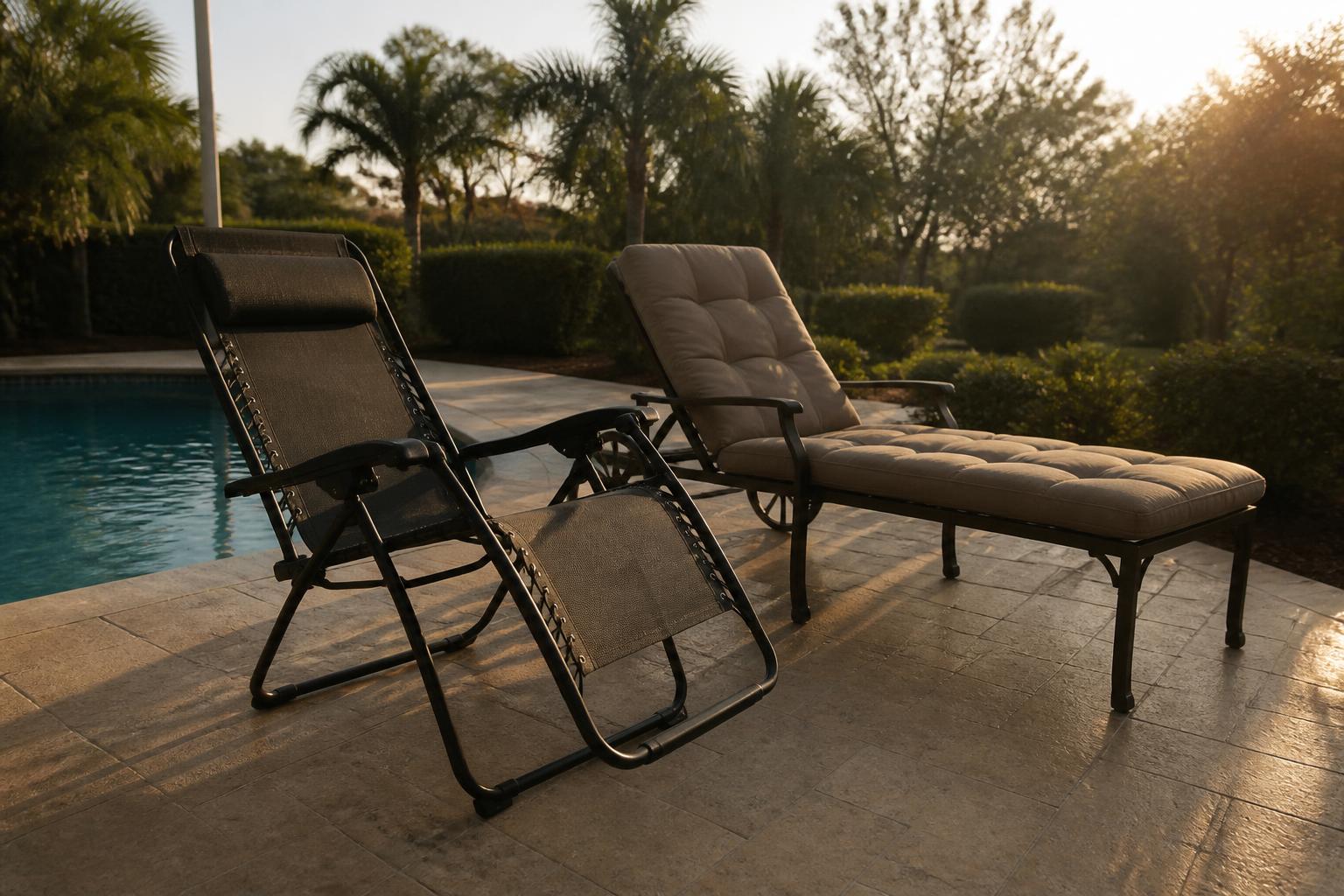
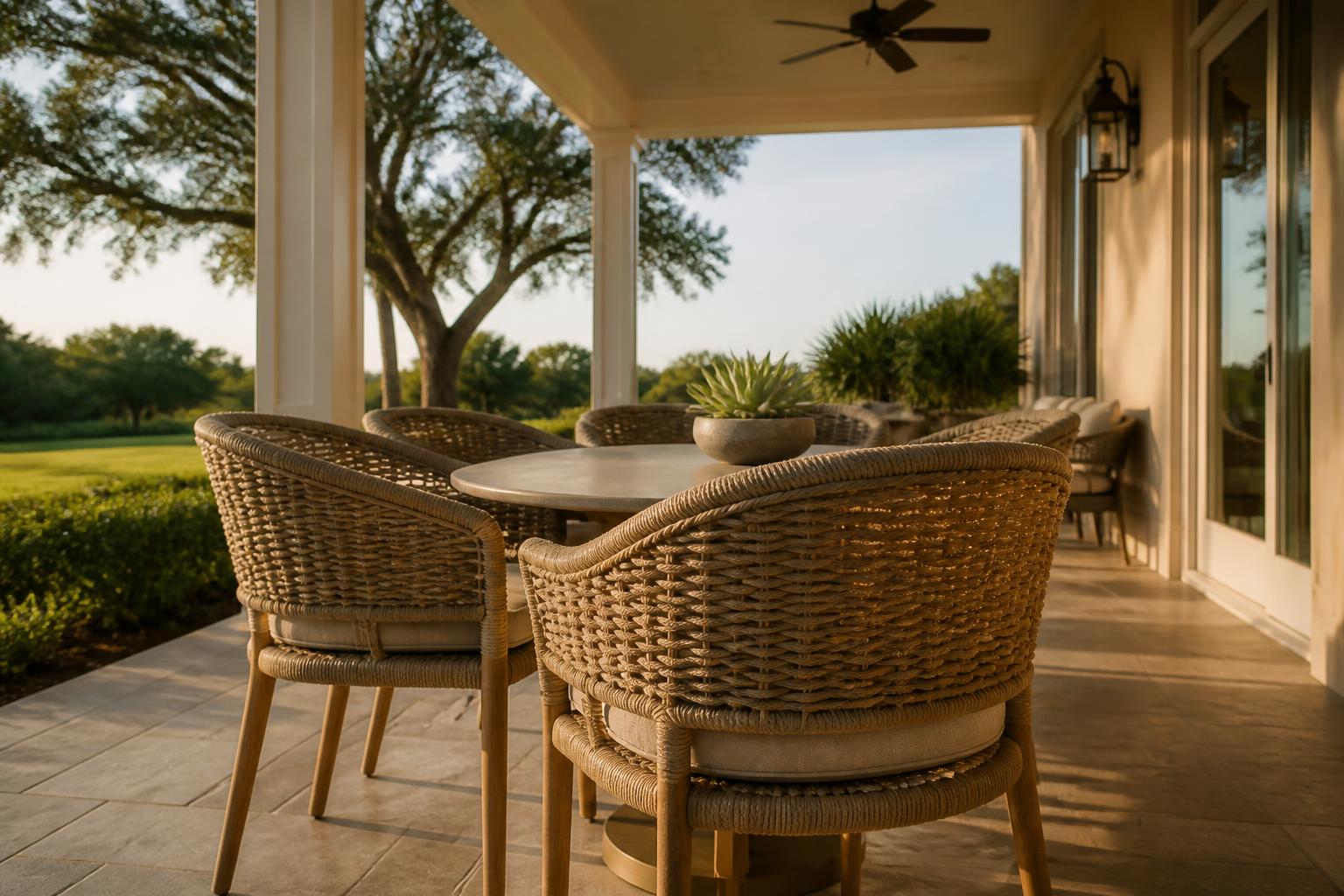
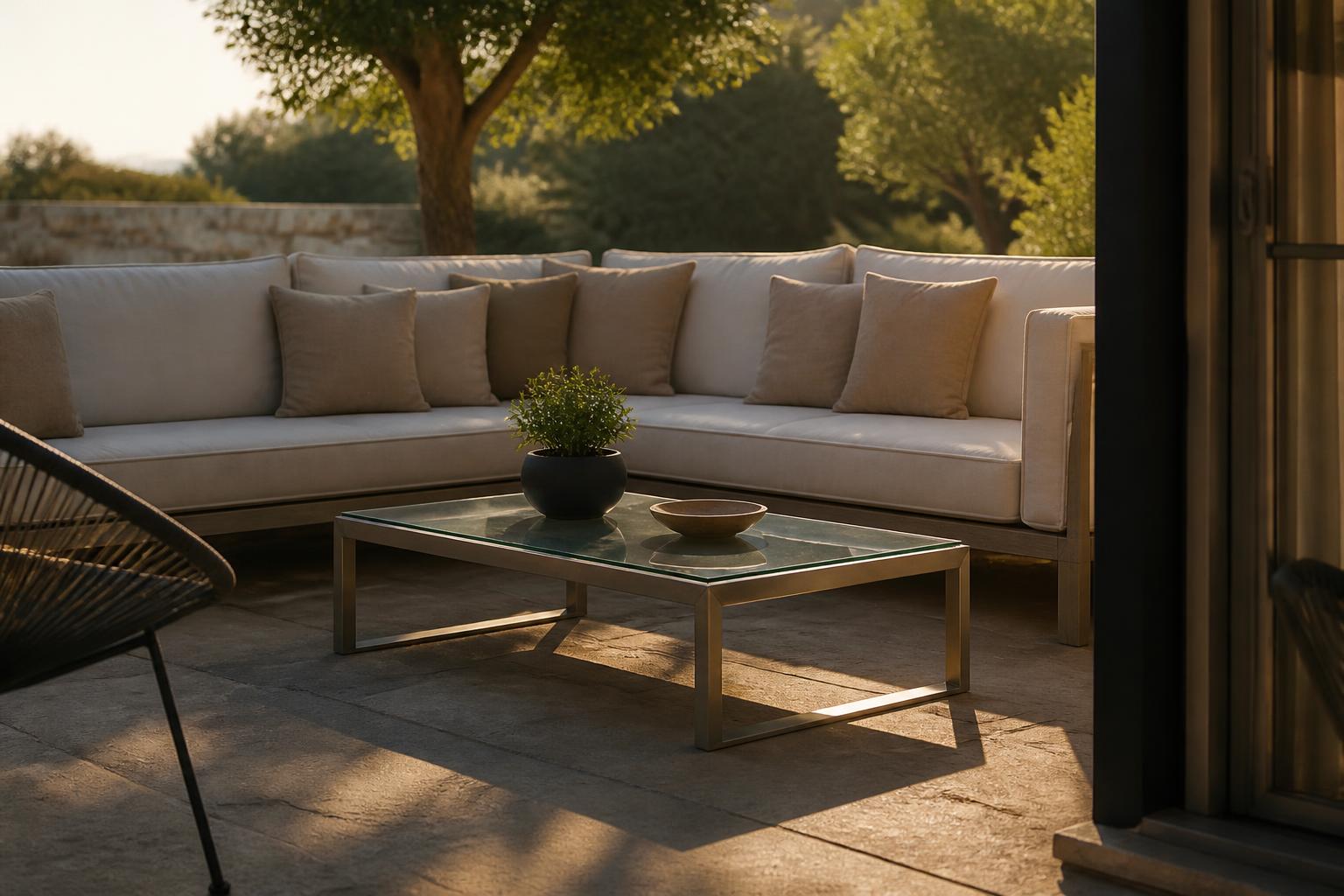
We sell a lot of deep seating sofas and sectionals out of our Jupiter showroom, and one detail that gets overlooked more than almost any other is the coffee table that goes in front of it. Customers will spend real time comparing cushion fabrics and frame finishes, then grab whatever coffee table happens to be nearby in the display — and end up with a table that’s the wrong height or too small once it’s actually in their own space. Here’s how we walk people through getting that pairing right.
Matching Table Height to Seat Height
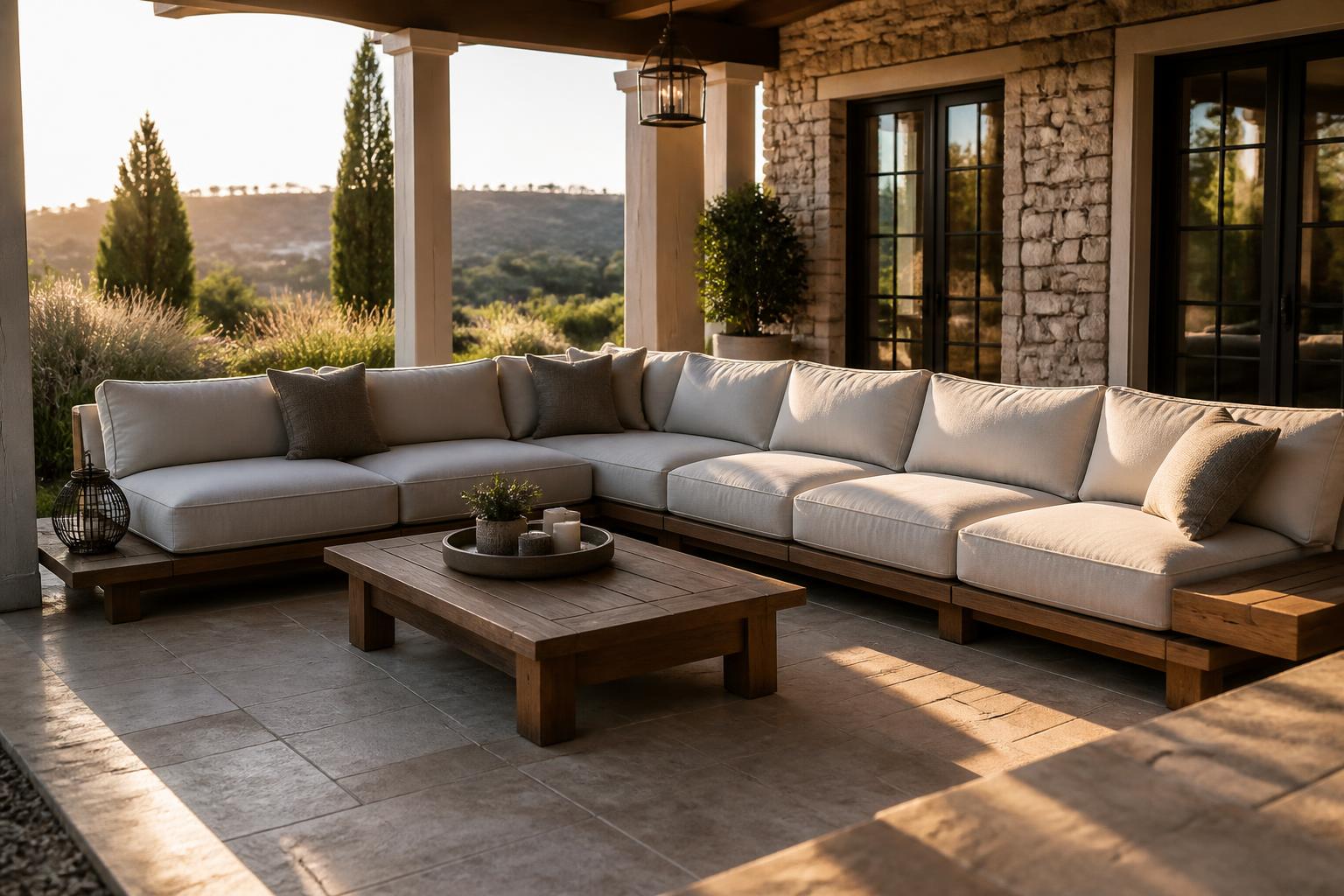
Deep seating sofas and sectionals sit lower than standard outdoor dining or bistro seating, usually in the 13 to 15 inch seat-height range once cushions are in place. The coffee table in front of that seating should sit close to the same height, ideally within an inch or two, so drinks and plates rest at a comfortable reach without anyone leaning up or down awkwardly. A table that’s noticeably taller than the seat height — closer to a dining or console table — looks and feels out of proportion in front of deep seating, even if the finish matches perfectly.
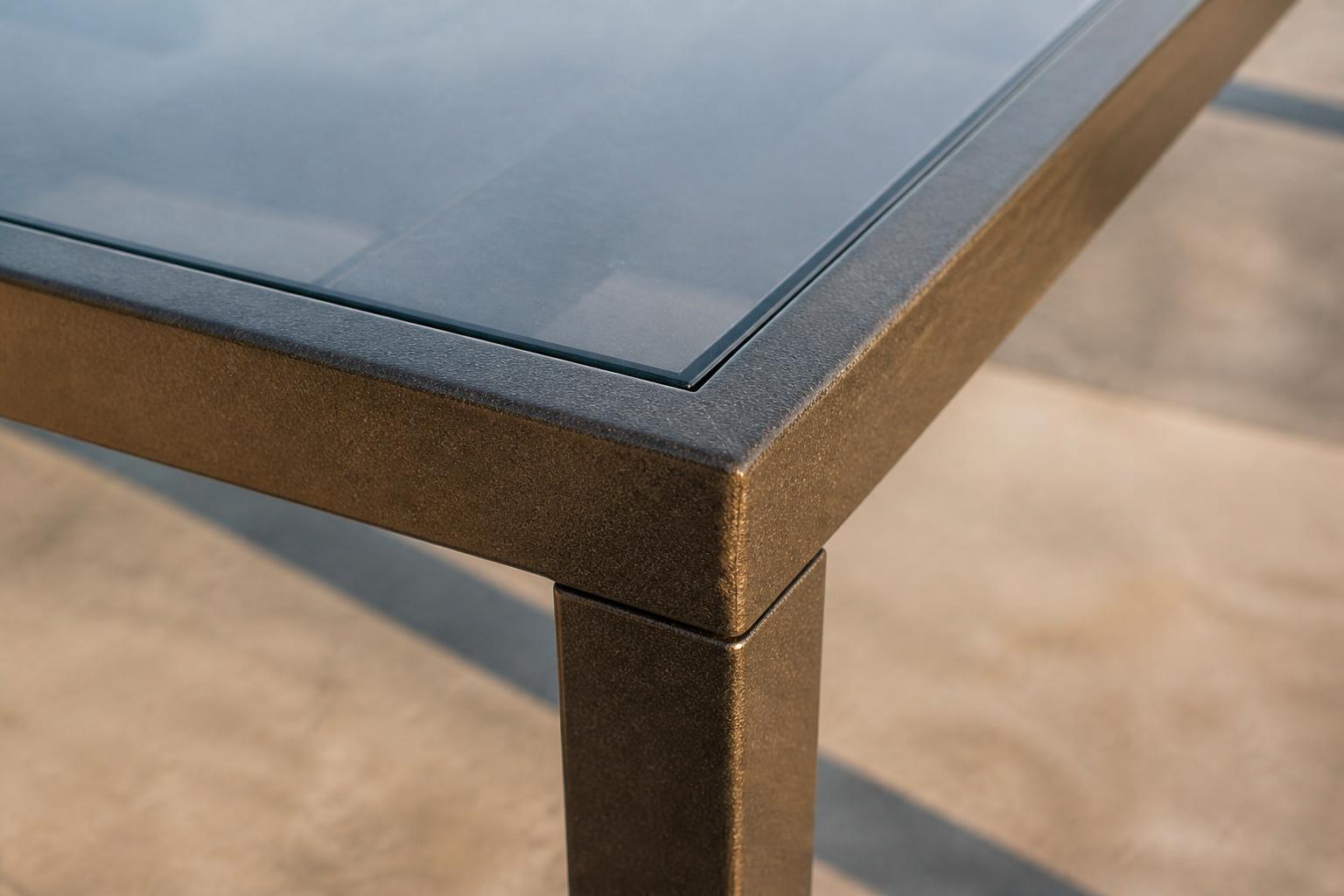
If you’re pairing a coffee table with sectional pieces of different depths (a chaise-corner unit versus a standard armless piece, for example), measure from the shortest seat in the group so the table works for everyone, not just the tallest section.
Sizing the Table to the Seating Footprint
A useful rule of thumb is to size the coffee table so it takes up roughly two-thirds the length of the sofa or sectional run it faces, with about 14 to 18 inches of clearance between the table edge and the seating so people can get up and sit down without banging their shins. For an L-shaped sectional, a square or rectangular table positioned toward the longer run usually works better than trying to center it perfectly in the corner, since that keeps it within easy reach of both sections.
If your seating group is large — a five- or six-seat sectional, for example — consider two smaller tables instead of one oversized table. It’s often easier to navigate around a lanai or pool deck with two lower-profile pieces than one large table that blocks a walking path.
Shape: Rectangular, Round, and Oval Options
Shape should follow the seating layout more than personal taste alone. A rectangular table generally pairs best with a straight sofa run or an L-shaped sectional, since its long edge can face the longest seating run for even reach from every seat. A round or oval table tends to work better in a U-shaped or fully wraparound seating configuration, since there’s no single “long side” to align — every seat ends up roughly equidistant from a round table’s center, which avoids the awkward reach some seats get with a rectangular table in a wraparound layout.
For corner or chaise-style sectional pieces specifically, a round table with a smaller footprint often clears the chaise’s extended leg rest better than a rectangular table with hard corners, which can end up closer to someone’s feet than intended once the chaise is fully reclined.
Material Pairing for Florida Outdoor Use
Glass-top coffee tables with an aluminum frame are popular for a reason — they’re easy to wipe down after pollen season and don’t hold heat the way a dark solid-top material can in direct sun. If your patio gets consistent direct sun, a lighter stone-look composite or a woven resin top stays cooler to the touch than tempered glass, which can get uncomfortably warm to rest a hand on by mid-afternoon. Whatever surface you choose, matching the table’s frame finish to your seating frame — both aluminum, or both a matching wood-tone poly lumber — keeps the whole grouping looking intentional rather than assembled piecemeal.
Lift-Top and Adjustable-Height Coffee Tables
A growing number of customers ask about lift-top coffee tables — models where the tabletop raises from standard coffee-table height up to a dining or working height, sometimes also sliding forward to expand the surface area. For a deep seating set that occasionally needs to double as a casual dining or laptop-working surface, this style solves a real space problem without requiring a second table nearby. The tradeoff is mechanical complexity: a lift mechanism has more moving parts than a fixed table, so it’s worth checking that the hardware is rated for continuous outdoor humidity rather than adapted from an indoor furniture design, since indoor-rated lift mechanisms can seize or corrode faster once exposed to Florida’s moisture levels.
Storage and Fire Table Compatibility
A number of customers replacing a coffee table are actually weighing it against a fire table instead, since both sit in the same spot in front of a seating group. If you’re set on a coffee table but still want the option of a fire feature down the road, look for a table height and footprint that would allow a small tabletop fire bowl to sit on top later, rather than assuming the two are mutually exclusive. And if your table needs to be moved indoors or under cover during storm season, confirm its weight and whether it has wheels or handles — a stone-look composite top in particular can be considerably heavier than it looks, which matters when two people are trying to move it quickly ahead of a storm.
Ottomans as a Coffee Table Alternative
Some households skip a traditional coffee table entirely in favor of one or two large outdoor ottomans, which double as extra seating when needed and add a softer visual contrast to a grouping of hard-surface tables elsewhere on the patio. An ottoman used this way should be topped with a tray for drinks and plates, since setting items directly on cushioned fabric isn’t practical, but the flexibility of occasional extra seating is a real advantage for households that regularly host more guests than their fixed seating comfortably accommodates.
Nesting Tables for Flexible Small-Space Layouts
For patios where floor space is genuinely tight, a nesting table set — two or three graduated tables that stack together when not in use — offers some of the same flexibility as a single larger table without the fixed footprint. Pulled apart, they can flank a sectional’s two ends or sit beside individual chairs; pushed together, they occupy a fraction of the space a single large coffee table would need. This approach works particularly well for condo and townhome patios where the seating arrangement itself might shift depending on the number of guests on a given day.
Once the coffee table fits your layout, check how its finish should be maintained. Tropitone’s product-care guidance provides an example of instructions organized by material.
Frequently Asked Questions
Should the coffee table match my sofa’s frame material exactly?
It doesn’t have to match exactly, but keeping the frame tone consistent (all aluminum, or all a similar wood-tone finish) reads as a cohesive set rather than mismatched pieces.
What if my deep seating set has unusually thick cushions?
Measure the actual seat height with cushions compressed under normal sitting weight, not the uncompressed cushion height, since that’s a more accurate number for matching table height.
Can I see how a table and sofa pair together before buying both?
Yes — our Jupiter showroom has full deep seating groupings set up with their matching coffee tables so you can see the actual proportions before you commit.
If you already have a deep seating sofa or sectional and need a coffee table that actually fits it, bring your seat height and sectional layout to our Jupiter showroom and we’ll help you size the right table in person. Call (561) 972-4661 to discuss your measurements and current options.

About the Author
Chas Crofoot
Chas Crofoot is the owner of Beach House Patio Furniture, a family-owned outdoor furniture company in Jupiter, Florida. Since 1979, Chas and his team have manufactured and sold high-quality patio furniture — specializing in wicker, cast aluminum, aluminum, poly lumber, and PVC pipe styles built to withstand the Florida climate. With over four decades of hands-on experience in outdoor furniture design and manufacturing, Chas brings deep expertise in material selection, durability, and comfort for coastal living.